El nen de 10 anys I Made Haris, fill del banjar Pujung Kaja, a uns 25 quilòmetres al nord d’Ubud, balla en aquest vídeo la dansa tradicional balinesa, clàssica per excel·lència, anomenada del guerrer o Baris. No hi ha cap home a Bali que en alguna etapa de la seva vida no hagi ballat el Baris, en la modalitat que veiem a les imatges o en alguna altra de tantes versions. El Baris del vídeo és la versió que s’ensenya a les criatures durant les classes que imparteixen al museu ARMA els més experimentats i acreditats professors de dansa tradicional balinesa d’Ubud. En Made és un dels alumnes que de ben petits assisteixen a les classes matinals dels diumenges. A Entre bambolines, podem veure com els pares del nen Made l’abillen i el maquillen a la galeria del museu abans de l’actuació que veiem en aquest vídeo. L’orquestra de gamelan que interpreta la peça és l’oficial de la institució docent i museística. L’ARMA és un emblema d’Ubud, un gresol d’art i cultura balinesa fundat el juny de 1996 pel mecenes, fill d’Ubud, Anak Agung Rai. Anak Agung Rai és un balinès conscient, coneixedor del risc que corre una cultura minoritària en un món globalitzat com el nostre. Tampoc ignora l’amenaça que comporta per a Bali formar part d’un estat que no posa gaire cura en protegir les diferents cultures emanants de la miríada d’illes que administra. El museu ARMA és un bastió contra l’aculturització de Bali. La tasca que fa per preservar l’essència balinesa és curosa i admirable.
Descripció tècnica: Vídeo gravat amb càmera digital compacta Sony Cyber-shot HX5V. Arxiu original: m2ts. Gravació sense trípode.
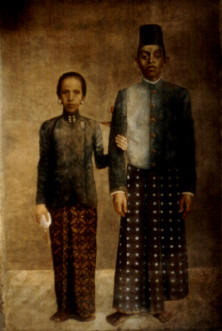
![Raden Saleh Sjarif Boestaman (1807[1] or 1811[2] - April 23, 1880) is one of the best known painters from Indonesia and a pioneer of modern Indonesian art. Raden Saleh, was born into a noble Javanese family. He was considered to be the first modern artist from the Dutch East Indies (now Indonesia), and his paintings corresponded with nineteenth-century romanticism which was popular in Europe at the time. He also expressed his cultural roots and inventiveness in his work. --European Sojourn-- Young Raden Saleh was first taught in Bogor by the Belgian artist A.J. Payen. Payen acknowledged the youth's talent, and persuaded the colonial government of the Netherlands to send Raden Saleh to the Netherlands to study art. He arrived in Europe in 1829 and began to study under Cornelius Kruseman and Andries Schelfhout. It was from Kruseman that Raden Saleh studied his skills in portraiture, and later was accepted in various European courts where he was assigned to do portraits. From 1839, he spent five years in the Ernst I court, Grand Duke of Saxe-Coburg-Gotha, who became an important patron. From Schelfhout, Raden Saleh furthered his skills as a landscape painter. Raden Saleh visited several European cities, as well as Algiers. In The Hague, a lion tamer allowed Raden Saleh to study his lion, and from that his most famous painting of animal fights were created, and subsequently brought fame to the artist. Many of his paintings were exhibited in the Rijksmuseum in Amsterdam. Several of his paintings were destroyed in when the Colonial Dutch pavilion in Paris was burnt in 1931. --Return-- The artist returned to Indonesia in 1851 after living in Europe for 20 years. Here, he worked as conservator for the colonial collection of government art. He continued painting portraits of the Javanese aristocracy, and many more landscape paintings. He died in 1880, after coming back from a second stay in Europe. --Diponegoro-- One of the creations Raden Saleh which gained popularity for its historical value was the 'Capture of Prince Diponegoro', which depicted a famous betrayal by the colonial government to the famous Javanese prince. It was returned to Indonesia from the Dutch royal Palace in 1978. Now it is displayed in the President's Palace Museum in Jakarta. In the painting, Raden Saleh is said to show his views of the colonialist governments from deliberately making the Dutch look pompous and proud, but somehow imbalanced. The Javanese, on the other hand, were depicted as somehow more balanced in composition. It is also believed that one of the Javanese figures in the painting was a self-portrait. (Wikipedia)](https://jaumemestres.cat/wp-content/uploads/2011/04/raden-saleh-arma-02.jpg?w=640)